
Prayer Times: Accurate Namaz / Salat / Salah Time for Your Location
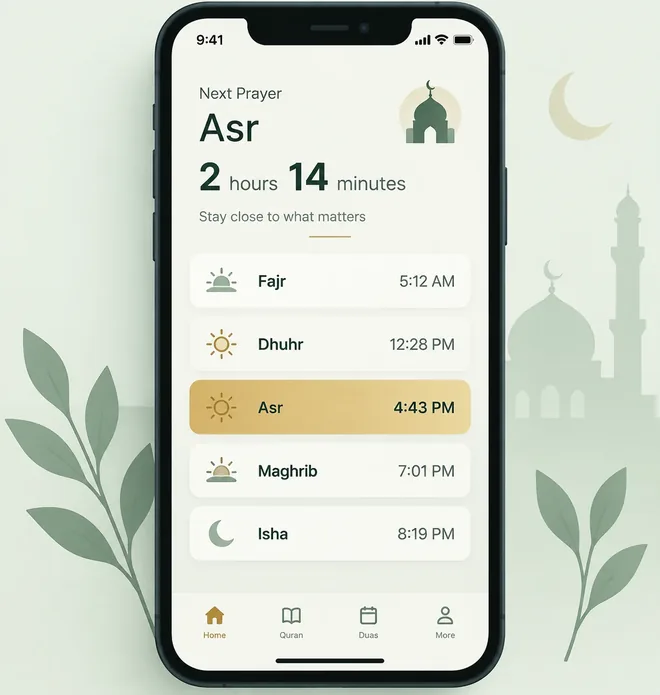
Knowing the exact time for each prayer matters every single day. This free tool shows accurate prayer times for Fajr, Dhuhr, Asr, Maghrib, and Isha based on your exact location, updated live as the sun moves through the sky.
Saturday, September 19, 2026 · Rabiʻ II 8, 1448 AH
Prayer Times Today: Live by Your Current Location
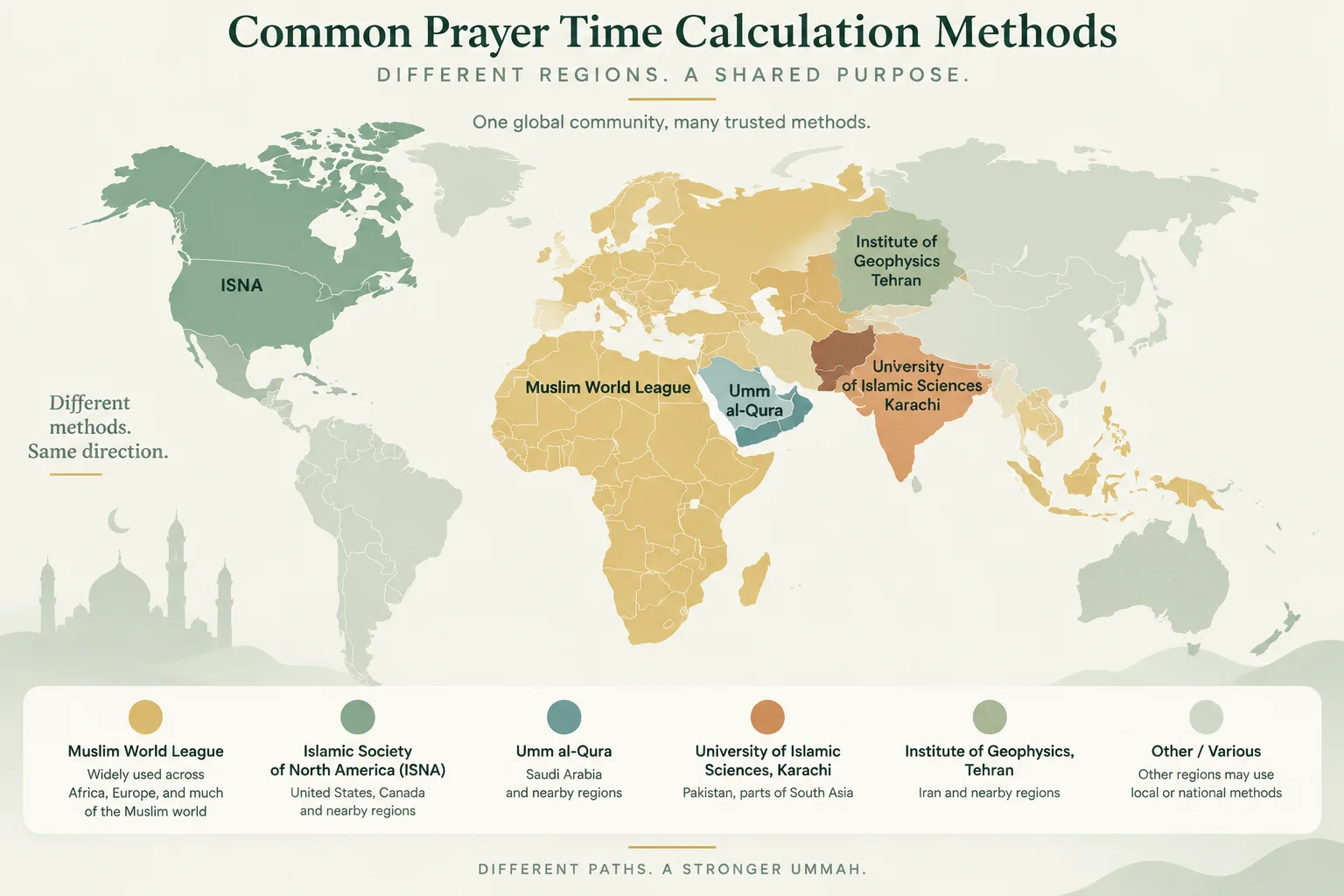
The five daily prayers are also called salah, salat, or namaz depending on where you live, but they all refer to the same obligation performed by Muslims worldwide. You can allow location access for live times, or search for any city by name if you are planning ahead or checking on behalf of family in another country. Choose from several trusted calculation methods, including MWL, ISNA, and Umm al-Qura, so the times shown match what your local mosque or community already follows.
What time is my next prayer? Allow location access at the top of this page and today's five prayer times appear automatically for exactly where you are standing. The panel highlights your current or next prayer and counts down the time remaining, so you always know how long you have before it begins.
These times shift a little every day because they are tied to the sun’s position, not a fixed clock. They also change with your time zone, your exact longitude and latitude, and daylight saving adjustments where they apply. A city just a short drive away can show a slightly different time, and that is expected, not an error in the tool.
Alongside the five prayers, sunrise is also shown as a sixth reference time. Sunrise itself is not a prayer, it simply marks the end of the Fajr window, but it is included since many people use it to plan the morning and to know when the Fajr prayer time has closed.
Every prayer begins by facing the Kaaba, so pair these times with our Qibla Finder to get your exact direction, and plan ahead for fasts and holidays using the Islamic (Hijri) calendar.
Fajr, Dhuhr, Asr, Maghrib, and Isha Time Explained
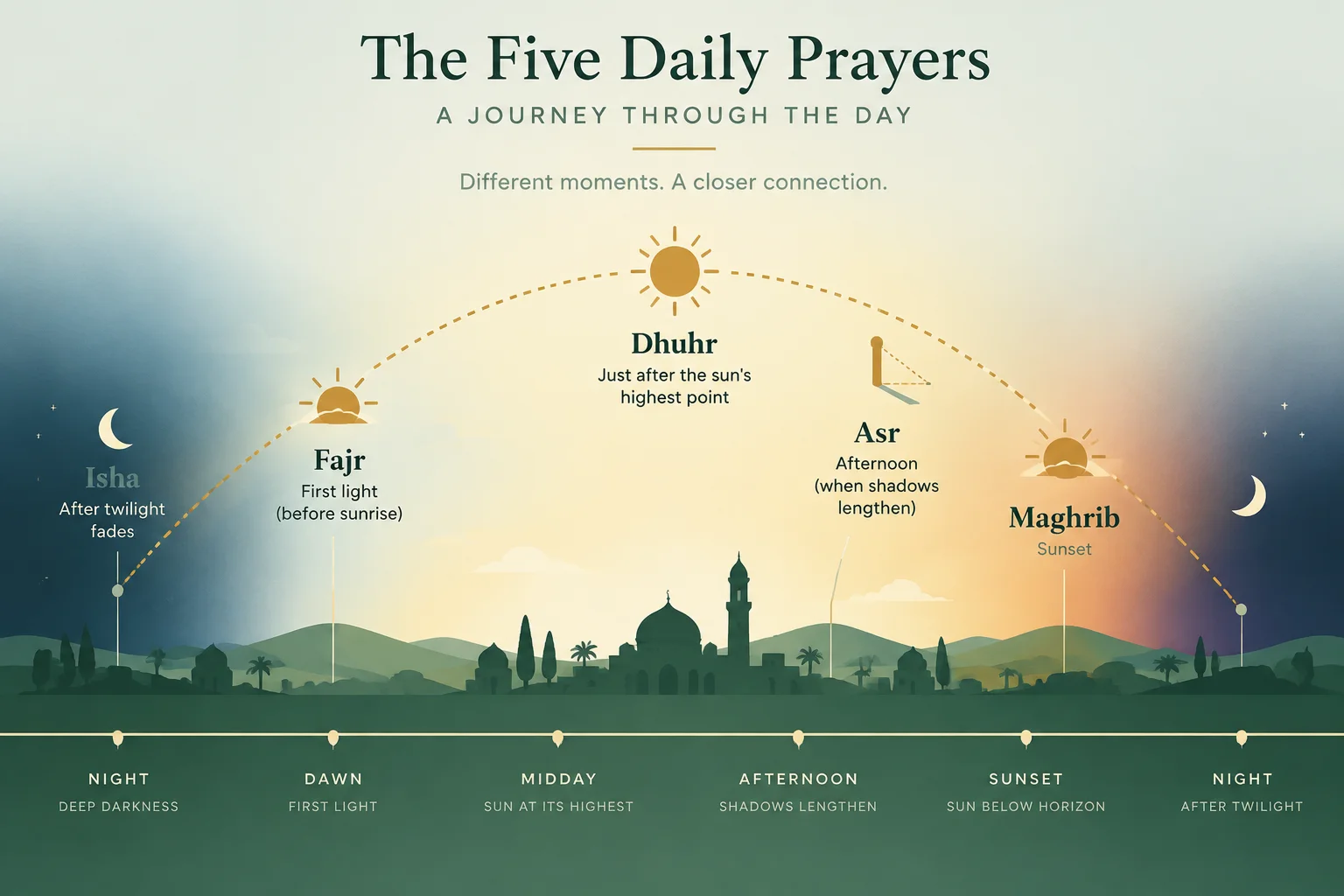
Each of the five daily prayers is tied to a specific position of the sun rather than a set clock time, which is why the exact minute shifts throughout the year. According to Encyclopaedia Britannica, these five prayers form the second Pillar of Islam and were established as obligatory within the lifetime of the Prophet Muhammad.
Fajr
The Dawn Prayer
What time is Fajr? Fajr begins at true dawn, when the first light appears low on the horizon, and ends at sunrise. This window can be short, so many Muslims set an early alarm to avoid missing it, especially in summer months at higher latitudes.
Dhuhr (Zuhr)
The Midday Prayer
What time is Dhuhr? Also spelled Zuhr, it begins shortly after the sun passes its highest point (solar noon) and continues until Asr begins. It falls roughly in the early afternoon and is often the easiest of the five to fit into a workday.
Asr
The Afternoon Prayer
What time is Asr? Asr begins once the length of an object’s shadow reaches a set multiple of its own height. The Shafi’i school, used as the standard setting, counts one shadow length, while the Hanafi school counts two — which is why Asr can differ by up to an hour between the Shafi’i (Standard) and Hanafi settings for the same city.
Maghrib
The Sunset Prayer
What time is Maghrib? Maghrib begins right at sunset. Its window is shorter than the other four, since it ends when Isha begins at the close of twilight — so it is worth checking the exact time here rather than guessing from when it gets dark.
Isha
The Night Prayer
What time is Isha? Isha begins once the last light of twilight disappears and lasts until Fajr starts the next day. In summer at higher latitudes it can fall close to midnight, while in winter it arrives much earlier in the evening.
Rak‘ah count by prayer (Fard and Sunnah)
| Prayer | Fard (obligatory) | Sunnah commonly prayed | Note |
|---|---|---|---|
| Fajr | 2 | 2, before Fard | Sunnah before Fajr is strongly encouraged |
| Dhuhr | 4 | 4 before, 2 after | Ten rak‘ah total in common practice |
| Asr | 4 | 4, before Fard (optional) | Sunnah here is recommended, not obligatory |
| Maghrib | 3 | 2, after Fard | — |
| Isha | 4 | 2 after, plus Witr | Witr is a separate, highly recommended prayer |
Jummah Prayer Time: The Friday Congregational Prayer
What time is Jummah? Jummah replaces the Dhuhr prayer every Friday and is performed together in congregation rather than alone. According to Encyclopaedia Britannica, the Friday service includes two short sermons (khutbah) delivered before the prayer begins, and traditionally requires a sizable gathering in one central mosque. The exact start time follows your local mosque’s own schedule, since it depends on when the community gathers rather than a fixed clock time, so it is worth checking with your mosque directly alongside the general Dhuhr window shown on this page.
Azan Time: The Islamic Call to Prayer
What is azan? Azan, also spelled athan or adhan, is called out at the start of each prayer’s time window to announce that it has begun. It is traditionally given by a muezzin, a person appointed to call the community to prayer, and today is often heard through a mosque speaker system or played automatically by an app like this one. Many people search for azan time specifically because they want an audible reminder rather than just a number on a screen, which this tool supports through optional alerts.
Salah Meaning: The Basic Steps of Prayer
What does salah mean? Salah, also called salat, is the Arabic word for the formal prayer Muslims perform five times a day. Namaz is the word used for the same prayer in Urdu, Persian, and Turkish, so all three terms point to the identical practice. Each prayer follows a set sequence of standing, bowing, prostration, and sitting, paired with specific recitations, all performed while facing the qibla, the direction of the Kaaba in Makkah.
Prayer Times App and Calculator: How These Times Are Calculated
How is this calculated? These times are worked out using your coordinates and the sun’s exact position on that date, then adjusted using a calculation method that sets the angle used for Fajr and Isha. According to Praytimes.org, an open technical reference used by many prayer-time tools, these angles typically range from about 15 to nearly 20 degrees below the horizon depending on the organization that set them — which is why two apps can show slightly different times for the same city. The Fiqh Council of North America recommends 15 degrees for both Fajr and Isha across the United States, which matches the ISNA method used by most mosques in that region.
Calculation methods compared
| Method | Organization | Fajr angle | Isha rule | Commonly used in |
|---|---|---|---|---|
| MWL | Muslim World League | 18° | 17° | Europe, much of Asia |
| ISNA | Islamic Society of North America | 15° | 15° | United States, Canada |
| Umm al-Qura | Umm al-Qura University, Makkah | 18.5° | 90 min after Maghrib | Saudi Arabia |
| Karachi | University of Islamic Sciences, Karachi | 18° | 18° | Pakistan, India, Bangladesh |
| Tehran | Institute of Geophysics, Tehran | 17.7° | 14° | Iran |
| Shia Ithna Ashari | Leva Research Institute, Qom | 16° | 14° | Shia communities worldwide |
Shia and Sunni Prayer Times: What's Different
What is the difference between Shia and Sunni prayer practice? The five prayer windows are the same for all Muslims, but many Shia Muslims combine Dhuhr with Asr, and Maghrib with Isha, into three daily prayer periods rather than five separate ones. This is a recognized and accepted practice, not an error, and this tool supports it directly through the Shia Ithna Ashari, or Ja’fari, calculation method, which delays Maghrib slightly and uses its own twilight angle for Isha. Sunni Muslims typically pray all five prayers separately at their individual times, though combining two prayers while traveling is also permitted in some circumstances across several schools of thought.
Frequently asked questions
Prayer times for any city in the world
Our prayer times tool works anywhere on Earth. It detects your exact location automatically and calculates accurate times for it — including major cities like these.
- Makkah
- Madinah
- Istanbul
- Cairo
- Dubai
- Karachi
- Lahore
- Jakarta
- Kuala Lumpur
- London
- New York
- Toronto
Explore More Islamic Tools
This page is part of a growing set of daily-practice tools. Qibla Finder shows the exact direction to face during prayer, and the Islamic Calendar gives today’s Hijri date, a date converter, and the full year with Ramadan, Eid, and Hajj dates.