
Islamic Calendar 2026: Today's Hijri Date, Months, and Date Converter
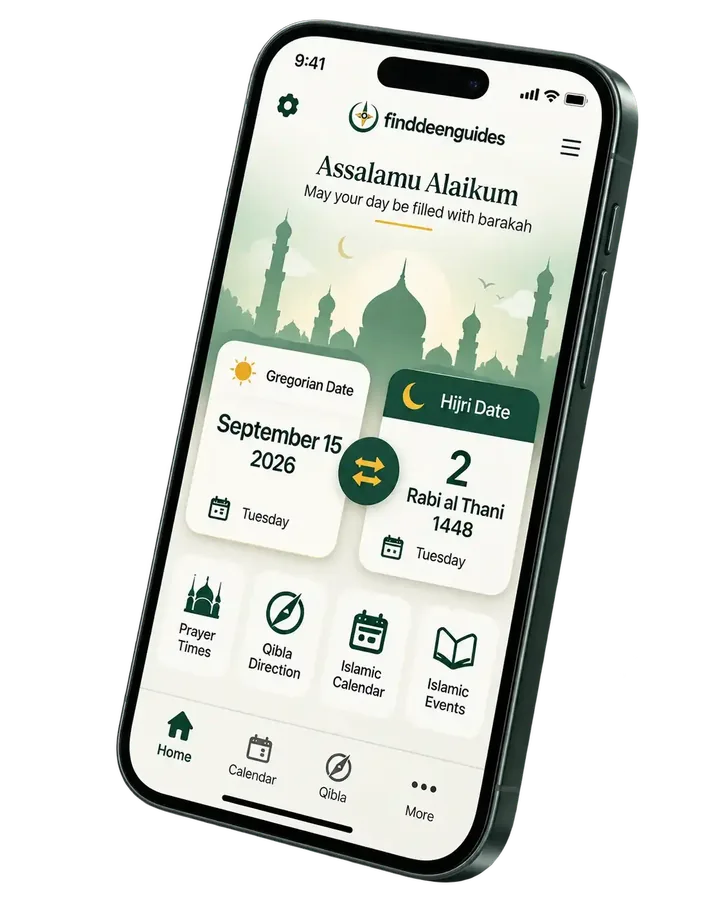
Knowing today's Hijri date matters for prayer, fasting, and every major Islamic event through the year. This page shows today's Islamic date next to the Gregorian date, updated live every day, with a full Hijri-to-Gregorian converter.
Today's Islamic Date and Hijri to Gregorian Converter
The Islamic calendar, also called the Hijri calendar, is a lunar calendar of twelve months that began with the migration of the Prophet Muhammad from Makkah to Madinah in 622 CE. Browse the Islamic calendar 2026 by month, check dates for Ramadan, Eid, and Hajj, and see how moon sighting or the Umm al-Qura standard can shift a date by a day. This page is built to work alongside our prayer times and qibla finder tools.
What is today's Hijri date? The live display at the top of this page shows today's exact Islamic date next to the Gregorian date automatically. Islamic days begin at sunset rather than at the start of the Gregorian clock day. Use the converter to check any date, past or future, in either calendar — useful for birthdays, anniversaries, or historical events.
The Islamic date today can differ by a day between countries depending on local moon sighting. Set your region above for the convention commonly followed there, and use the ±1 day toggle next to the date if your local mosque announced a different start. This is explained in full in the moon-sighting section further down this page.
Once you know the date, keep the rest of your day aligned with accurate prayer times for your location, and make sure you’re facing the Qibla wherever you are.
Upcoming Islamic dates
Ramadan, Hajj & Eid
Islamic Calendar 2026 with Holidays: Monthly Grid and Printable PDF
A full monthly calendar grid, viewable online or printed, with every Gregorian date matched against its Hijri equivalent and major holidays marked. Use the year selector to browse any month from 2018 through 2029.
Major Islamic holidays, estimated 2026 Gregorian dates
| Holiday | Hijri date | Estimated 2026 Gregorian date |
|---|---|---|
| Isra and Mi’raj | 27 Rajab | Mid January 2026 |
| Shab e Barat | 15 Shaban | Early February 2026 |
| Start of Ramadan | 1 Ramadan | February 18, 2026 |
| Eid ul-Fitr | 1 Shawwal | March 20, 2026 |
| Day of Arafah | 9 Dhul Hijjah | May 26, 2026 |
| Eid ul-Adha | 10 Dhul Hijjah | May 27, 2026 |
| Islamic New Year (1448 AH) | 1 Muharram | June 16, 2026 |
| Ashura | 10 Muharram | June 25, 2026 |
Moon phase today
Islamic Calendar 2026: Hijri Year to Gregorian Year
What year is it in the Islamic calendar? The Islamic year is about eleven days shorter than the Gregorian year, since it follows twelve lunar months rather than the sun. One Gregorian year almost always overlaps two different Hijri years — which is why Islamic calendar 2026 corresponds to parts of both 1447 AH and 1448 AH. The table below shows this correspondence, and every year in range is browsable in the calendar tool above.
| Hijri year (AH) | Approx. Gregorian start | Approx. Gregorian end |
|---|---|---|
| 1440 | 2018 | 2019 |
| 1442 | 2020 | 2021 |
| 1444 | 2022 | 2023 |
| 1446 | 2024 | 2025 |
| 1447 | 2025 | 2026 |
| 1448 | 2026 | 2027 |
| 1449 | 2027 | 2028 |
| 1450 | 2028 | 2029 |
Islamic Months: Names, Order, and Meaning
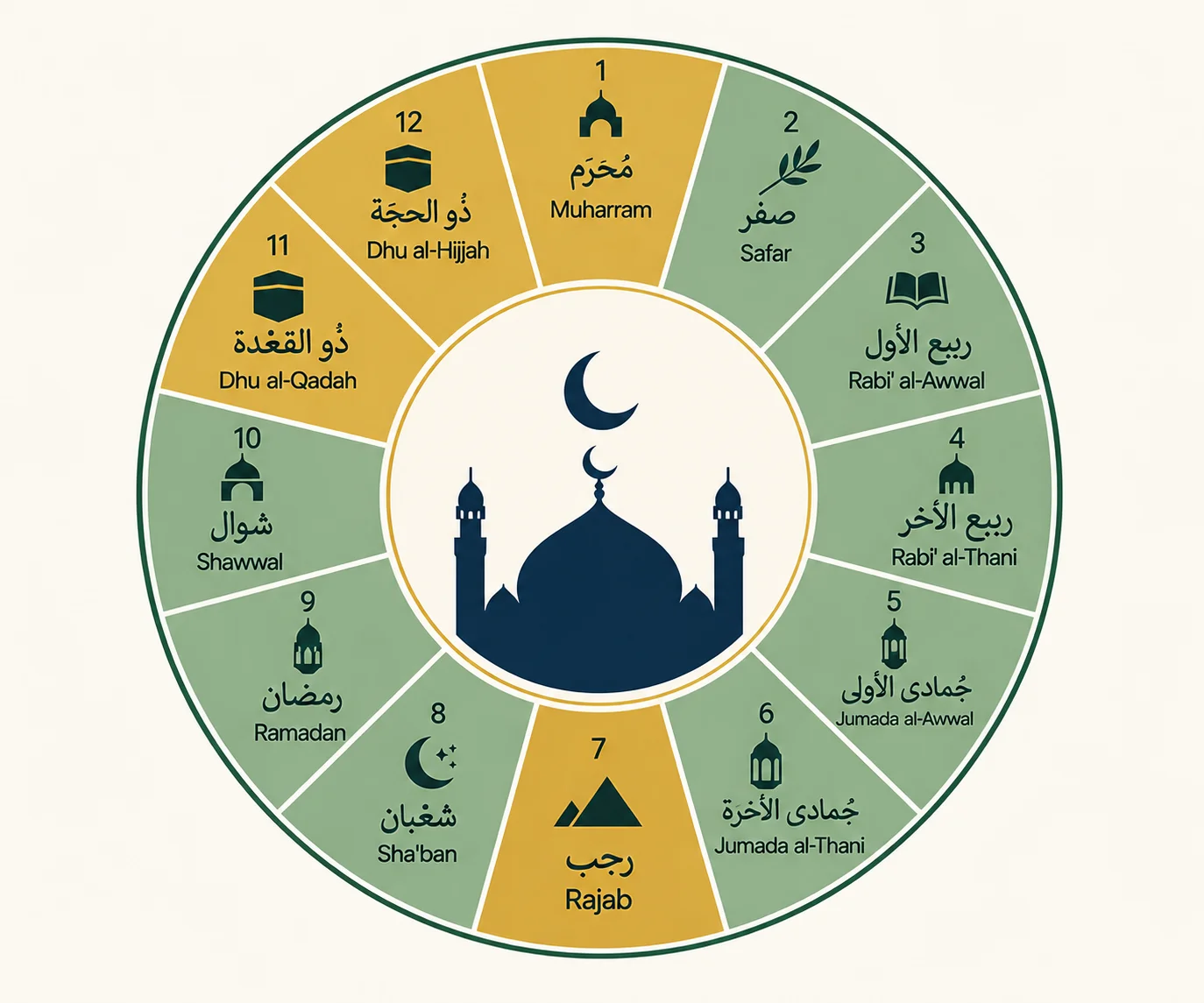
What are the names of the Islamic months in order? According to Encyclopaedia Britannica, the twelve months are Muharram, Safar, Rabi al-Awwal, Rabi al-Thani, Jumada al-Awwal, Jumada al-Thani, Rajab, Shaban, Ramadan, Shawwal, Dhul Qadah, and Dhul Hijjah. Four of these — Muharram, Rajab, Dhul Qadah, and Dhul Hijjah — are considered sacred months, a distinction referenced in the Quran (Surah At-Tawbah, verse 36).
| Order | Month | Notable significance |
|---|---|---|
| 1 | Muharram | Islamic New Year, Ashura on the 10th |
| 2 | Safar | No major fixed event |
| 3 | Rabi al-Awwal | Traditionally linked to the Prophet's birth |
| 4 | Rabi al-Thani | No major fixed event |
| 5 | Jumada al-Awwal | No major fixed event |
| 6 | Jumada al-Thani | No major fixed event |
| 7 | Rajab | Isra and Mi’raj on the 27th |
| 8 | Shaban | Shab e Barat on the 15th |
| 9 | Ramadan | Month of daily fasting |
| 10 | Shawwal | Eid ul-Fitr on the 1st |
| 11 | Dhul Qadah | Sacred month, start of Hajj season |
| 12 | Dhul Hijjah | Day of Arafah, Eid ul-Adha, Hajj |
The Significant Months of the Islamic Calendar
Some months carry a fixed annual event that shapes worship and community life. Each is covered below, with today's position within it shown live at the top of this page.
Muharram & the Islamic New Year
Muharram is the first month of the Hijri calendar and marks the Islamic New Year on its first day. The tenth of Muharram, known as Ashura, is significant for both Sunni and Shia Muslims, though observed differently between the two traditions.
Rajab & Shab e Meraj
Rajab is one of the four sacred months and is best known for Isra and Mi’raj, the night journey, commemorated on the 27th of the month. Many communities mark this date with extra prayers and reflection.
Shaban & Shab e Barat
Shaban falls just before Ramadan and includes Shab e Barat on the night of the 15th, regarded by many Muslims as a night of forgiveness and preparation for the fasting month ahead.
Ramadan, the Month of Fasting
Ramadan is the ninth month and the month of daily fasting from dawn to sunset. Its exact start depends on sighting the new moon at the end of Shaban, so the estimated date in the holidays table should be confirmed closer to the time.
Shawwal & Eid ul-Fitr
Shawwal begins immediately after Ramadan, and its first day is Eid ul-Fitr, marking the end of the fasting month with communal prayer and celebration.
Dhul Hijjah, Hajj & Eid ul-Adha
Dhul Hijjah is the final month and one of the four sacred months, home to the Day of Arafah on the ninth and Eid ul-Adha on the tenth — the two days that anchor the annual Hajj pilgrimage to Makkah.
Safar, Rabi al-Awwal, Rabi al-Thani, Jumada al-Awwal, and Jumada al-Thani complete the rest of the year. Rabi al-Awwal is traditionally linked to the birth of the Prophet Muhammad, while the remaining months carry no fixed annual event in most traditions.
Moon Date Today: How Moon Sighting and Lunar Calculation Work
Why do Islamic dates differ between countries? Each new Islamic month begins with the sighting of the crescent moon, and moon sighting itself cannot be calculated in advance — it depends on real observation, weather, and which authority a community follows. Because of that, the moon date shown on this page is calculated using the Umm al-Qura standard, the same fixed, deterministic method Saudi Arabia’s official calendar uses, so it can always be computed instantly rather than waiting for a sighting report.
To account for the gap between calculation and confirmed sighting, this page lets you set your region so the date matches the convention commonly followed there, and offers a manual ±1 day adjustment next to the date for anyone whose local mosque announced a different start. Neither the calculated date nor a local sighting is wrong — they simply answer different questions. A small number of communities, mostly among Shia Muslims, also follow a different point for the start of the Hijri year count.
Frequently asked questions
Explore More Islamic Tools
This page is part of a growing set of daily-practice tools. Prayer Times shows accurate daily prayer times for your location. Qibla Finder shows the exact direction to face during prayer. Islamic Calendar converts between the Hijri and Gregorian calendars.